HOTT 52 - Getting Ready
(See [1] for what HOTT is, if you've never heard of it before.)
I'm going back in time, though, back to the last published version of HOTT, 1.2, which is now available again on Lulu! After playing a version of HOTT that was updated for the latest DBA 3 rules, I've decided to go back. Not because the update HOTT2DBA3 rules are bad, but because a lot of HOTT play at conventions/events is still based on 2.1. I wanted to re-familiarize myself with the actual version.
I was reading through my well worn copy of the rules and kept finding odd notations that implied I had done something earlier, so I went through my Google Drive and found this:
HOTT Reference Sheet (Google Drive Link)
The first page is written for my Etinerra campaign world, and I converted the measurements to inches because "'Murica", but the rules summary works very well as a one sheet/two page summary of the game.
Rather than try to do a huge big restart to my wargames campaign in Etinerra, I'm just going to play some games with miniatures and get to playing HOTT regularly, THEN I can see about tying things back to Etinerra. So this coming weekend, I will do two games to catch up with the weeks - last weekend was all about my playtest of Hommlet!
While I love Chaos Wars and still play it, HOTT is perfect for an hourlong game that gives me some fun, but doesn't require a lot of time.
Thanks, Kaptain Kobold, for the inspiration!
[1] HOTT/Hordes of the Things is a fantasy miniatures wargame that uses a small number of figures to play out just about any fantasy setting you can imagine. It also allows you to make just about any army you can imagine, with an army list that ranges from high Tolkein fantasy, to Asian Indian mythology, to Discworld and even Christmas Land! The rules can be interesting to interpret, with "Barkerese" on the same level as "High Gygaxian" in terms of writing. There's a ton of help on the web and my reference sheet to help you with the rules!
Star Wars Jedi Fallen Order Free Download
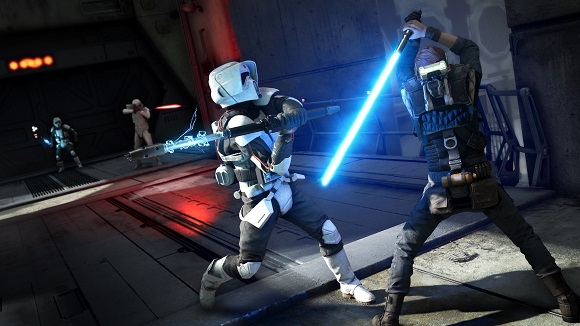
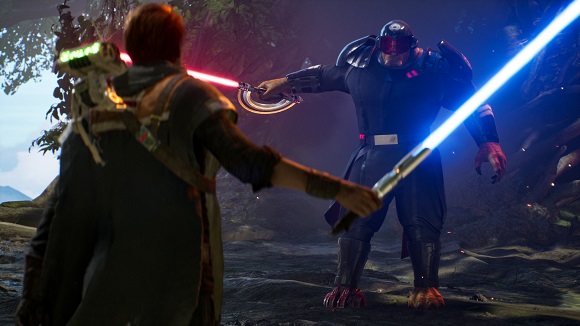
While mastering your abilities, players will engage in cinematically charged lightsaber and Force combat designed to deliver the kind of intense Star Wars lightsaber battles as seen in the films. Players will need to approach enemies strategically, sizing up strengths and weaknesses while cleverly utilizing your Jedi training to overcome your opponents and solve the mysteries that lay in your path.
Star Wars fans will recognize iconic locations, weapons, gear and enemies while also meeting a roster of fresh characters, locations, creatures, droids and adversaries new to Star Wars. As part of this authentic Star Wars story, fans will delve into a galaxy recently seized by the Empire. As a Jedi hero-turned-fugitive, players will need to fight for survival while exploring the mysteries of a long-extinct civilization all in an effort to rebuild the remnants of the Jedi Order as the Empire seeks to erase the Jedi completely.
GAMEPLAY AND SCREENSHOTS :
DOWNLOAD GAME:
♢ Click or choose only one button below to download this game.
♢ View detailed instructions for downloading and installing the game here.
♢ Use 7-Zip to extract RAR, ZIP and ISO files. Install PowerISO to mount ISO files.
INSTRUCTIONS FOR THIS GAME

SYSTEM REQUIREMENTS:
(Your PC must at least have the equivalent or higher specs in order to run this game.)
• Requires a 64-bit processor and operating system
• OS: 64-bit Windows 7/8.1/10
• Processor: AMD FX-6100/Intel i3-3220 or Equivalent
• Memory: 8 GB RAM
• Graphics: AMD Radeon HD 7750, NVIDIA GeForce GTX 650 or Equivalent
• DirectX: Version 11
• Storage: 55 GB available space
Recommended:
• Requires a 64-bit processor and operating system
• OS: 64-bit Windows 7/8.1/10
• Processor: AMD Ryzen 7 1700/Intel i7-6700K or Equivalent
• Memory: 16 GB RAM
• Graphics: AMD RX Vega 56, Nvidia GTX 1070/GTX1660Ti or Equivalent
• DirectX: Version 11
• Storage: 55 GB available space
If you have any questions or encountered broken links, please do not hesitate to comment below. :D
The Last Sane Man In A World Gone Mad
The passing of The Daily Banter's Chez Pazienza is a great loss to journalism that few will ever know about. While The Banter, which he co-founded with Bob Cesca, is small potatoes compared to the Internet powerhouses of Buzzfeed, Salon, Vox, and The Huffington Post, he helped bring something to the online paper that is quickly become a dying practice: quality writing. In the obsessive desire for traffic and shares, otherwise reliable bastions of liberal thought have devolved into cheap listicles and sensationalist outrage blogging. It is a dumbing down of the Left comparable to what Rush Limbaugh and Sean Hannity did to the Right.
A lone auteur in a wilderness of mediocrity.
Chez was left-wing P.J. O'Rourke with a sharp scintilla of Hitch. He opposed nonsense and bullshit wherever he saw it, from the hourly insanity of President Trump, to the maddening political correctness on colleges, to the insipid humor of Jimmy Fallon, to the left-wing nihilists who refused to vote for Hillary, to the self-destructive madness of the Republican Party, and the inability of many liberals to be frank about critiquing Islam. I didn't always agree with Chez, nor did I always agree with Hitch, but what they held in common, for me, was their witty and no-holds-barred takes the latest news events. Their perspectives were always fresh, often sating my hunger for something savage, contrarian, and nuanced all in the same piece.
If there were an overriding theme to Chez's latest Banter writings, if one can be salvaged, it'd be that America is going further and further down the shithole of absurdity, with the only comforting reprieve being the ability to laugh in defiance like George C. Scott riding the nuclear bomb in the finale of Dr. Strangelove. Literary voices like Chez are a dying breed. Even The Washington Post and The New Republic are falling prey to the Buzzfeed effect. Gravitas on the guillotine.
In his death, however tragic, it can hoped that Chez'll receive the due recognition that he deserved in life. I could quote any number of passages from his long bibliography to give you an idea of what I'm taking about, but I think it most prescient, given the toddler-in-chief, that I quote from one of his more recent warnings about Trump, as he tried tirelessly to resist the normalization of this imbecile of a president in the media, a resistance that we need to continue,
"So the time for arguing amongst ourselves over petty outrages and miniscule transgressions is over. It has to be. We don't have the time for it anymore. Those closest to Trump's firing line within our diverse population will be counting on every single decent person in this country to take a stand for them and the only way we can do that is with a unified front and sheer numbers. Our voices have to be loud. Our anger has to be righteous and it needs to be seen and heard in everything from our politics and those who speak for us politically, to our music, to our art, to even, ironically, our comedy. We're already seeing our artists, creators, and thought leaders giving us a hint of what might be to come. And come it must. That's the voice of the resistance."
Further Reading
Chez Pazienza's Articles For The Daily Banter.
http://thedailybanter.com/author/chez-pazienza/
"In Memory Of Chez Pazienza, The Writer I Always Wished I Could Be."
http://thedailybanter.com/2017/02/in-memory-of-chez-pazienza/
Bibliography
Pazienza, Chez. "Make America Rage Again." The Daily Banter, November 10, 2016. Web. http://thedailybanter.com/2016/11/make-america-rage-again/
Gears 5 Free Download
Gears 5 PC Game 2019 Overview
It's about time. Suit up with a WWE Superstar Batista skin for use in Gears 5 multiplayer. Play Gears 5 while online between Sept 15 (4:00pm PT) and October 27 (11:59pm PT) to get him in game for free.
From one of gaming's most acclaimed sagas, Gears is bigger than ever, with five thrilling modes and the deepest campaign yet.
Campaign: The world is crumbling. The Swarm has corrupted the Coalition's robot army and is descending upon human cities. With danger closing in, Kait Diaz breaks away to uncover her connection to the enemy and discovers the true danger to Sera – herself.
Escape: Outrun the bomb, outsmart the Swarm, and escape the Hive! Escape is a new, aggressive, high-stakes co-op mode featuring a three-player suicide squad that must work together to take out enemy hives from within.
Versus: May the best team win! Rack up points and trade up for superior weapons in Arcade, a frenetic playlist built for jump-in, over-the-top fun. With ten other game types plus new and classic maps, Versus rewards every competitive style, from casual to pro.
Horde: Can you and four friends endure waves of ever-stronger enemies and bosses? Survive using new hero abilities, building defenses, collecting power, leveling up your skills and working as a team.
Map Builder: Create custom Escape hive maps and experiences to share with and challenge your friends.
Features:
* Three-player Campaign Co-op: Battle alongside your friends in three-player online or split-screen co-op.
* Tours of Duty: Rank up from new recruit to four-star general in Gears Tours of Duty. Take on new and exciting challenges, earn awesome rewards, and show off your loot.
* Boot Camp: New to Gears or just a little rusty? Bootcamp is a fun way to learn the ropes, from the basics to advanced combat techniques.
* Play as Jack: Play as Jack, your personal flying support bot that can protect allies and damage enemies – perfect for players new to Gears.
* Visual Showcase: Play every mode in 4K and HDR at a smooth 60 frames per second on compatible machines
Technical Specifications of This Release.
- Game Version :
- Interface Language: English
- Audio Language : English
- Uploader / Re packer Group:
- Game File Name : Gears_5.rar
- Game Download Size : 63 GB
- MD5SUM : d4a175b90286efbbec8ed0c0c9f89209
System Requirements of Gears 5
* OS: Windows 7 SP1 64-bit, Windows 10 64-bit
* Processor: AMD FX-6000 series | Intel i3 Skylake
* Memory: 8 GB RAM
* Graphics: AMD Radeon R9 280 | NVIDIA GeForce GTX 760 (Windows 10) | NVIDIA GeForce GTX 1050 (Windows 7)
* DirectX: Version 12
* Network: Broadband Internet connection
* Storage: 80 GB available space
* Sound Card: DirectX compatible
* OS: Windows 10 64-bit
* Processor: AMD Ryzen 3 | Intel i5 Skylake
* Memory: 8 GB RAM
* Graphics: AMD Radeon RX 570 | NVIDIA GeForce GTX 970 (Windows 10) | NVIDIA GeForce GTX 1660ti (Windows 7)
* DirectX: Version 12
* Network: Broadband Internet connection
* Storage: 80 GB available space
* Sound Card: DirectX compatible
Gears 5 Free Download
Download BOS Wars 2.7 RTS For Windows
Bos Wars is still a nice fast-paced and somewhat lightweight RTS for you to enjoy, even though the sound mixing is still brutal but getting your hands on the latest Version for Windows is not as straightforward, as it was in 2010.
Thankfully, you can get a working version for Windows from Portableapps.
The cool 3D pixel soldier in the thumbnail above is from OpenGameArt by the way. Still kicking, old design and all.
This post was retrieved from freegamer.blogspot.com.
Zombies In My Pocket?!
Still in tons of pain from my back but I did manage to get a ga,e of Zombie in my pocket in.
While packing up games I came across my ol' ZIMP pop which used to be my all time favorite travel game so I knew what I wanted to play this evening.
After moving more stuff today I realized that I had packed it away. :/
Really itching to play the game I decided to see if there was an app for the game by chance... thankfully and much to my surprise there is!
It's a great adaptation of the game and really is fun! Unfortunately for me, I ended up dying but that wont be the last time, lol!
As always, thank you for reading and don't forget to stop and smell the meeples! :)
-Tim
Logo
When it came to staff shirts, we resorted to white embroidery on black shirts. originally I had white shirts with a full color logo, but those were loathed by everyone, and they were hard to keep clean. You may not know this but everything we sell sits in a dirty warehouse before getting to us and gets even dirtier as it sits on our shelves. Keeping a retail store clean is a major feat, as it starts dirty and only gets worse. White shirts were always getting stained and looking bad.
The black, embroidered shirts we currently use, with a boring plain white stitched logo, turned out to be incredibly expensive. Each shirt costs $70 with embroidery. They also need to be made in batches in various sizes, so we're almost always buying more than we need, in sizes we hope will be useful. Invariably, those sizes don't match our diverse staff. So over time, we've been stuck with a box of very expensive shirts in the wrong sizes. The cost of bad design turns out to be very high.
Our new shirt design features a full color patch that can be sewn onto a variety of shirts. We choose the shirt from the Work Wear store next door, grab a patch, and sew it on. No big batches of variable sized, expensive, embroidered, logo perverting shirts. Also, if I want one of my robust, tactical shirts from 5.11, I buy it in the right color and sew on the patch, something not available before. Total cost per shirt for employees will be $25 or so, with no waste.
Then there's the increased merchandising we tend to avoid with the old logo. We've already ordered new patches, pins, stickers, and more. We'll have hats and t-shirts eventually. These were difficult to design with the old logo requirements and they sold poorly.
Now let's get onto the minor controversy of our design choices. We spent about a month defining the needs of the new logo with half a dozen designers. We identified core requirements. It should maintain the design elements of the old logo: the knight, the horse, the lance, the direction it's all headed (very symbolic) and of course, a diamond. The logo needed to remain fairly simple. The name needed an updated font that was compact with the design. The previous font used long, horizontal text and has been nothing but trouble for 15 years. The color black is problematic. It goes with nothing but white. Those who use black in their logos hamstring themselves design wise, so we omitted that. In fact, I would probably pick a different store name without a color in the title if I were to do it over. I have few regrets, but "black" is one. Let's take a look at the new design:
I think it pops. Rather than black, we have a dark blue, which works much better and represents one of our colors. It's a darker blue than our original logo (which some say was purple, a color I love). The diamond color, away from black, represents a shift in store colors that came about with our big construction project, three years ago.
Missed Classic 80: The Price Of Magik (1986) - Introduction
![]() |
| Magik witk k, bekause it sounds kool? |
I said an, not the end. With these two games, a certain phase in the development of Level 9 is coming to a close. Looking back at all the products of Level 9 I've played, it seems that their most creative phase was with their four first games. Their first game, Colossal Adventure, itself mostly just a feat of importing an existing game from mainframe to PC, served as a template for all their Treasure Hunts, by which I mean a game where the main goal (aside from possible end sequence) is to maximize your score by collecting as many treasure items as possible (treasure items being usually, but not always, of no use beyond their role as treasure). The most perfect example of a Treasure Hunt in Level 9 collection was their third game, Dungeon Adventure, which.got rid of everything superfluous, like end sequences, and concentrated on looting treasures within the most fiendish puzzle box the developers could think of.
The second Level 9 game, Adventure Quest, could be said to form a template of Travel Story, where plot progression means basically advancement into a new map area (although backtracking might be allowed) and where main goal is to get to the final room (and possibly carry something into the final room or do something there). Travel stories Level 9 perfected with their fourth game, Snowball, where you have to move through a spaceship full of dangers into the final room where a terrorist is hiding with a bomb.
After this first round of creativity, the development of Level 9 games has been mostly technical - they added pictures and streamlined their parser - while most of their games still used the two templates. Lords of Time, Emerald Isle and Red Moon were again Treasure Hunts, although two of them tried to hide this fact with a meatier plot. Return to Eden, on the other hand, was like a bad parody of a travel story, with player walking through disconnected areas containing various threats to a trial, which they will lose unless they carry the right items with them.
This doesn't mean Level 9 had completely stopped innovating. Interestingly, their imaginative side showed most with their games made for Mosaic. Partly these innovations must have been caused by a desire to make easier games. This is especially true with their take on CYOA genre, where The Secret Diary of Adrian Mole served as template and The Archers brought that template to fruition, especially by making the point system of the first game more sensible and giving real options for the player.
A more interesting novelty was what I could call a Game of Exploration, to which The Saga of Erik the Viking served as the template. The idea behind the name is simple. After a short introductory sequence, game world - big, but empty, as has been the case with Level 9 games - opens up almost completely, with only few hidden and/or closed spots. The task of the player is to explore this world, with no real idea what to look for (there are even no treasures to be discovered), and find the key items required for triggering the end game. This template was perfected in The Worm in Paradise, where the dystopian-bureaucratic context and the amnesia of the player character made the mindless exploration understandable.
The reason of this long prologue is that I feel The Price of Magik falls squarely into the Exploration type. It at first seems like it would be another Travel Story, but then… and now I am getting ahead of myself.
![]() |
| First few rooms |
Let's begin with the premise of the game. The Price of Magik continues the story of Red Moon, which was basically a tale of finding a stolen artifact (titular Red Moon of Baskalos), which was the source of all magik. In this game, the artifact is stolen again! The supposed guardian of the Red Moon, Myglar, wanted to make himself immortal and channeled all its energy to this task. Because of this, Red Moon is about to fade and magik will disappear.
Manual reveals also that the player was transferred to the House of the Red Moon magikally, after blowing and exploding a big red balloon found in an attic. I have a feeling nothing at all will be heard about this story in the game itself.
At the beginning of the game I found myself at the driveway outside the yard. There was a woodshed, leading to a herb garden, each containing a number of objects, some of which required some small scale puzzle solving (for instance, I could use a candle to burn a pile of wood into ashes).
The house itself could be entered from two directions - through the front door or by climbing a vine to the attic. It was completely dark inside, but herb garden had contained some eyebright flowers, which were said to miraculously improve vision when rubbed into your eyes.
Let's start describing the house itself from the top. There was a small attic, consisting only of few rooms. Among other things, the attic contained a mirror, which I could cut to pieces with a diamond ring. Beyond the mirror I found a prism, which had the word XAM written on it.
![]() |
| The attic |
This is the perfect time to speak of the magic system. Just like in Red Moon, you need two things for doing magic - spell word and corresponding focus. In Red Moon, the spell words, the required foci and the effects of each spell were described in the manual. No such luck here. Spell words - always consisting of three letters - are scattered around the game world, for instance, examining the knocker at the front door revealed the word ESP. Helpfully, if you try to cast a spell, but you don't yet have the focus, the game will tell you what focus you'll need.
Spell words seems to have some relation to the effects - you could think XAM might be about examining and ESP about telepathy - but it needs some research to verify what a spell actually does. As a book found within the house has told me, the game has three kinds of spells - spells you just cast generally, spells you cast to some direction and spells that you cast at some object/character (player included).
Interestingly, magic affects your characteristics. You start the game from the ripe age of 20, and each spell you cast makes you older - when you turn 100, you die. Magic is also connected to your sanity - the less sane you are, the more power your casting has. Naturally you want to reduce your sanity as much as you can, so how do you do it? Well, finding spell words and foci and casting spells for the first time does this. In addition, there are other events that shake your sanity - for instance, if you knock on front door, some nameless monster appears for a second and frightens you.
So, you'd think the game would be spent in searching new spell words and foci. Yet, the very first spell I found changed this radically - when I used XAM at any focus, I would learn what spell it was a focus for, thus making all spell words hidden in the house redundant. I then quickly learned that one focus - a piece of mirror I had just acquired - changed the game even more radically. The mirror let me cast ZEN, which gave me access to "mists of time", which was essentially just a quick way to access nearly all of the map and even places that at this point would have otherwise been closed off from me (changing this from Travel Story to a Game of Exploration).
I decided I wanted to play this game more organically, learning spell words as I discovered them in the house and accessing new places only after I had solved the necessary puzzles (like Captain Kirk said, we are meant to fight our way through and claw every inch, not stroll to the sound of flutes). Back to mapping, then. Since most of this was pretty humdrum, I'll try to be terse, indicating only the more interesting things I found and puzzles I solved.
![]() |
| My very own sidekick |
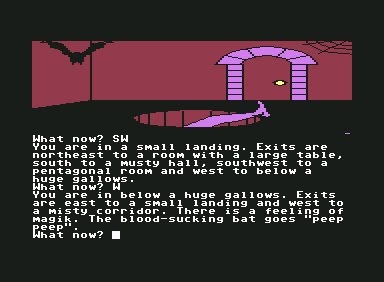
The most interesting thing in the second floor was a bat that started to follow me. It took me a while to get this, but the HYP(nosis) spell let me command creatures. When I HYPnotized the fellow, it helped me to catch a moving wheel (another focus). Other puzzles on this floor were simple, once I found proper spells. There was one secret room containing lever, pulling of which released a sword. I also found an inscription of a spell on a roof, which I could read only by using the spell FLY on myself.
![]() |
| Second floor |
Finally, there was a room full of chests of many different colours. Opening up a wrong one created an explosion that hurt my stamina. It all came down to using the DOW spell - meant for checking if an item is magical - to find the one I could open safely, Inside, I found some salt.
![]() |
| I really don't want to know what's going on here... |
The bottom floor was the largest in the house. The most remarkable thing I found in it was the Red Moon I supposed I was searching for. I couldn't take it, because its magic gave me a jolt, but touching it rejuvenated me, making my age quite irrelevant. I also could levitate the Red Moon with my FLY spell, revealing yet another spell word (DED).
![]() |
| Partial map of the first floor |
In addition, I met a ghost, who was willing to give me its old armour, if I just buried all his bones, scattered in few places. I had already found a shovel, and a good burial place was in the garden.
I also met my first hostile creatures: werewolf, wight, skeleton and a giant slug. The game has a combat system, but just like in Red Moon, I assume it's completely useless. Indeed, I could walk around the wight, the skeleton wandered from one room to another and the wolf was scared of wolfsbane. And the slug? It didn't like salt.
Beyond the slug opened up a whole new, underground section of the game. Having now searched through the house proper, I think it's best to end the post. The main problem, as in many earlier Level 9 games, is that the game world is too sparse in comparison with its size - I've spent most of time mapping, instead of solving puzzles.
Spells (if I've "officially" found them) - foci (if I own them) - what they do: ESP - ? - ?, ? - candle - ?, ? - ashes - ?, DET - elder cross - detect danger, XAM - prism - checks if target is focus for some spell, ZEN - mirror - rapid movement, MAD - grimoire - make target mad, HYP - staff - hypnotises targets, ? - valerian - ?, DED - wheel - cancels spells, FLY- broom - makes target fly, DOW - pendulum - check if target is magical, BOM - ? - ?, SEE - feldspar lense - finding secret doors
Inventory otherwise: mandrake, skull, knucklebone, ring, eyebright flowers, cage, robes, knife, wolfsbane, shovel, plate armour
Square Tiling Of A Sphere, Part 1/3
I almost always work on 2D game maps, but occasionally I get intrigued by planetary maps. I'd like to make a planet that uses a grid. The topology of a sphere requires a few things:
- Moving east or west you eventually wrap around the world → easy
- Moving north/south you eventually reach a pole, and then all directions are south/north → medium
- Wrapping around the world east/west is shorter near the poles than near the equator → hard
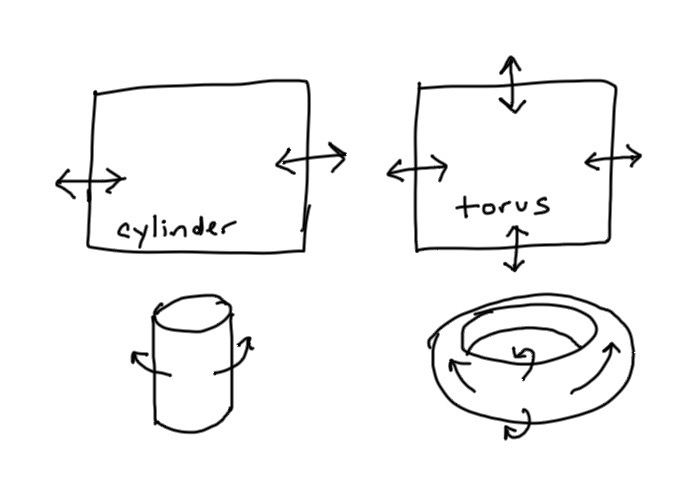
Some grid games like Civilization will let you wrap east/west but not north/south. That acts like a cylinder, not a sphere. And some grid games will let you wrap north/south just like you wrap east/west. That acts like a torus, not a sphere. A tile grid game that acts like a sphere is hard!
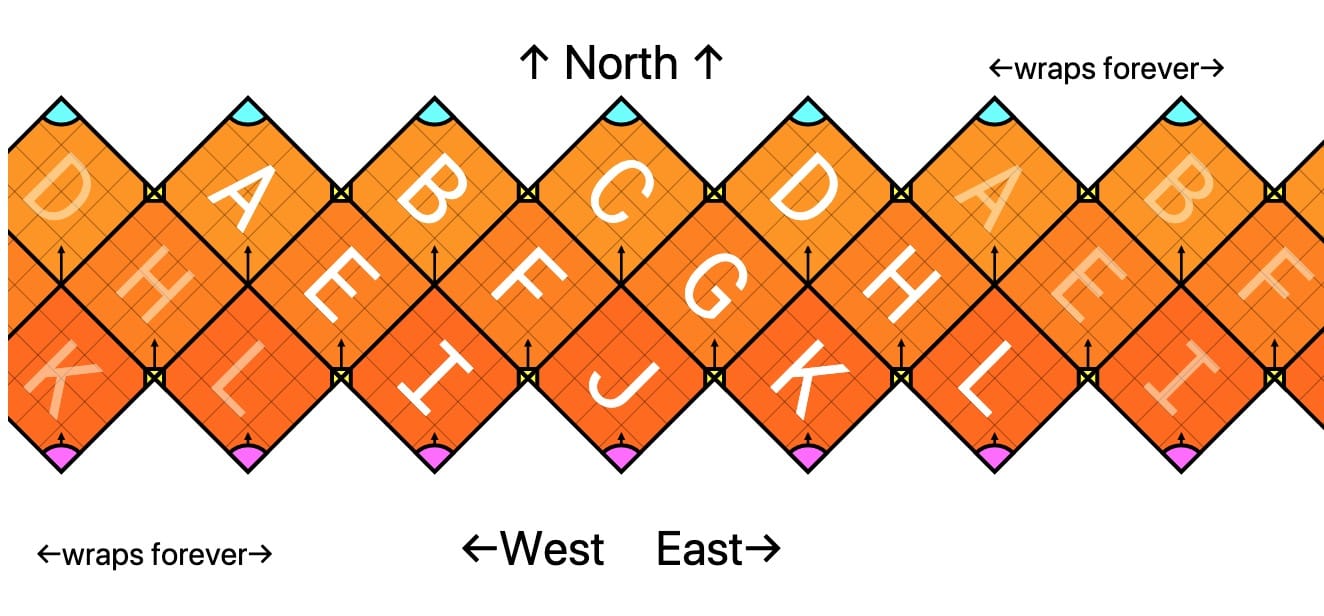
A few years ago I played with hexagons covering a sphere. The main idea was that although there are some pentagons scattered around, we can hide them by making the map generator produce impassable terrain (deep oceans, inaccessible mountains, lava, etc.) in those areas, so you can never get close to the pentagons. Also, we have to divide the planet into regions that get shuffled around as you move around. While I was working on that I found some other things I wanted to try, but I didn't try them right away. Why?
I have three kinds of projects:
- My "main" projects (hexagonal grids, pathfinding, etc.) are about making high quality explanations. I'll spend a lot of time on these. I usually understand the topic reasonably well.
- My "gamejam" projects like this one are about exploring new things. I'll spend a limited amount of time (hour, day, or week) on these. I usually don't understand the topic that well.
- My "art" projects are about making something that looks cool.
Since I limit my time on each of the "gamejam" style projects (marked with an /x/ in the URL), once I run out of time, I'll stop, and make a list of things I want to explore later. For the hexagons-on-a-sphere project, I wanted to try squares-on-a-sphere, but didn't have time. I decided to explore that topic last week. I started with HEALPix, a layout used by NASA for placing quadrilaterals on a sphere, but I concluded that it's overkill for my needs. NASA also has the COBE quadrilateralized cube, and there are several other layouts to try. But I'm out of time, so those will be in a future "gamejam" style project. As often happens, I realize towards the end that I should've read more papers first, but sometimes I don't know what to look for until after I've tried implementing something.
Read about covering a sphere in square tiles
We're Launching An Official Discord Server!
Join our server here!
Frictional Games is a distant and cryptic game developer, quietly tinkering with unspeakable horrors in the darkest depths of Europe. Yet over the past while we have been chipping away at that image, exposing a softer core. And now we're ready for the final nail in the coffin of mystery: an official Frictional Games Discord server, where you can talk directly to us, or to other fans!
We hope that having a fluid, shared space like this will help casual and hardcore fans alike connect over topics that interest them, from lore conversations to sharing the cutest K8 plushie sewing patterns, from best uses of AddUseItemCallback to fanfiction tips. And, of course, anything and everything Frictional Games.
Aside from community-centered involvement, we hope to bring us developers closer to you with events like Ask Me Anything threads, and an occasional casual chat. Who knows what else the future will bring?
Upon launch the server includes channels for:
- Frictional's news, sales and patch notes,
- Discussions about SOMA, Amnesia games, Penumbra games and Frictional Games in general,
- Showcasing your mods and other fan creations like art, cosplay and videos,
- Connecting with peers and discussing modding, creating fanart, or how to avoid overheating when wearing a Grunt suit,
- Social media feeds,
- Buying our games directly from Discord.
To celebrate the launch, all our games are heavily discounted at the Discord store pages.
Welcome!
PS. We are open to getting a few more members for our moderator team, especially persons to balance out the majority of men. Contact community etc manager Kira for more details!
Planet X3 - Review Of A New Real Time Strategy Game For The IBM PC
![]() |
| Title Screen VGA |
Read more »
R.I.P. Matthew Frederick, One Of The Great Unpublished Game Designers
In the early days of BGDF, I read a lot of posts, I wrote a lot of posts, and I spent a lot of time in the IRC chat room with some of the forum regulars. Several of those regulars have gone on to see great success in the game industry as designers, artists, or publishers (or all three)!
One of those regulars, an admin in fact, went by the handle FastLearner. His name was Matthew Frederick. Matthew was ever-present, always insightful, and always made sure the forums were going strong. He's the one that created this BGDF logo:
A logo I placed on the back of the box for both Terra Prime and Eminent Domain, as a nod to the role the forums played in the design of those games.
One of my favorite aspects of the site was something called the Game Design Showdown, which turned into a monthly design challenge where, given a week and a theme, component restriction, or other guidelines, you could submit an entry. Entries were posted anonymously, and then voted on. There was no prize, and the submissions were not intended to be finished, tested games anyway, but the challenge was a good way to exercise the design muscles, and I know of several ideas from the GDS that went on to become fully fleshed out (and in some cases published) games. I say that's what the GDS turned into, but it started as a sort of real time challenge in the chat room, run by FastLearner, where instead of a week to come up with a game idea, you had just minutes! We only did that a couple of times, but it was great fun, and it opened the door to the larger Game Design Showdown, which still runs today if I'm not mistaken.
As it happens, Matthew lived in Phoenix, AZ -- just up the street from my hometown of Tucson. A couple of times I drove up and got together with Matthew... we talked about our game designs, even played each other's games. Matthew was one of the players who I wrangled into may first two playtests of UK designer David Brain's prototype: All For One, and we did a prototype swap (I left 8/7 Central with him, and brought home his mountain climbing themed game: Everest). I recall several of Matthew's games that I played, and they were all very good:
Everest was a middle-weight euro-style game about drafting a team of climbers (with sponsorship from various countries), and climbing Mount Everest. There were different terrain types to navigate, and your climbers were better at some than others. You could set up camps along the way where you could rest your team. There were rewards for reaching certain elevations first, including a large reward for reaching the top of the mountain. It was a real, honest to goodness game, on par with a lot of the stuff I've played off store shelves.
Velociracers was a card driven game where you, a Velociraptor, raced around an island grabbing up eggs and trying to keep ahead of the T-rex that was hot on your heels. Each turn you would play one of your cards, and you wouldn't get them back until you did a special "rest" action. There were mechanisms in place to keep the dinos bunched in a pack -- a headwind to keep the front runners from getting too far ahead, and cards that let you advance more the farther back in the pack you were. Fall too far behind and the T-rex will hurt you, much like taking damage in Snow Tails. Like all of Matthew's games, this felt fully fleshed out, even if he wasn't happy with it.
Elvencraft was another excellent design, where you would move around an Elven village in the trees, connected by bridges (which I think you would build, if I remember correctly), collecting items and crafting them into better items. I don't remember all the details of this one, but I do recall it feeling like a real game as well.
Cow Tipping was a small, Rummy-style card game that a nascent TMG considered publishing. It had adorable art and a cute theme of gangs of cows taking revenge on people by tipping over vehicles stopped in traffic. Motorcycles required a smaller gang (set or run) of cows to tip, but are worth fewer points. Buses were the most valuable, but of course required the largest gangs to tip. I recently re-read my email threads with Matthew about this game.
As a neophyte developer, I was perhaps overzealous about wanting to change Cow Tipping a lot. In the end, TMG did not publish that game, but Matthew gave me some important feedback that I still need to take to heart at times- he said something to the effect of "with all those changes, what exactly are you licencing from me?" That is a significant question for a few reasons. Not only was it a wake up call to me as I stepped into the game industry as a professional developer, but it also stands in stark contrast to some of the sentiments I've seen in modern designers who might submit an unfinished game with the expectation that the publisher will finish it for them. In contrast, all of Matthew's games were fully fleshed out, thoroughly tested, and more complete than many submissions I've received over the years.
About a decade ago, I lost touch with Matthew. I wasn't hanging out in the BGDF forums anymore, and I didn't travel to Phoenix very often. I didn't have much occasion to reach out to him, and from what I could gather, he had a very busy life, sometimes plagued with additional hardships outside his own control. I did follow Matthew on Twitter, and occasionally saw some snippet of his life scroll through my timeline, and every time it made me wonder "what ever happened to that guy?"
Back in October, just a few months ago, Matthew sent me a Twitter DM, seemingly out of the blue. It was a very complimentary message, just saying that he was pleased and impressed to hear how well I'm respected in the industry. Apparently Matthew had followed my career, or was at least aware of it. He followed that with another message:
Perhaps one day we'll get together again and reminisce about the old days and talk about what's happened in the intervening years.Two months later, I was sad to hear that Matthew was gone. I had gathered from tweets I'd seen that Matthew was sick -- fighting some kind of cancer. I know now that his message to me was something of a "goodbye," and I'm sorry I didn't drop everything right then and there and drive up to Phoenix to see him one last time, maybe play a game, or do that reminiscing he mentioned.
Matthew, I'd like to thank you for being the man that you were. The pillar of the game design community which brought me from a casual Magic player to a professional game designer. You are far and away the best designer I know, and the gaming world is poorer now that you're gone.
You will be missed.
Thoughts On Detroit: Become Human
Quantic Dream learns with each game, and adresses their issues with new features. But with new features come new issues, and lots of juicy design lessons. In this blog post I will talk at length about affordance, then touch upon branching and themes.
Intro
It has been a while since my last design blog, and I felt it was finally time to write one again. And since I just played through Detroit: Become Human, that's what I decided to write about.
First off, let me say that I quite liked the game. I had issues with how they tackled some of the themes (especially in regards to robots), and felt they could have taken some aspects of the world they created more seriously.
What made up for the so-so narrative bits were the production value (such as some very cool environments), and the myriad of exciting scenarios. It's not an easy feat to create scenes that are not just narratively compelling, but also engaging play-wise – especially not in the sort of story that Detroit tells.
On top of this, the branching and the choice possibilities in Detroit are insane. It is a lengthy game, taking well over 10 hours to complete, and yet as the story unfolds there is a constant stream of differences that all depend on your previous choices. Everything to how crime scenes change to how characters make remarks depending on how you played some previous scene is amazingly well done. The scenes are constantly constructed from a wide array of options, but everything flows together into a coherent whole. Other branching games, such as Hidden Agenda, have a much more jarring presentation where the inserted lines and cuts in the flow are obvious. In Detroit, flow flaws are basically nonexistent.
So, it is fair to say that production-wise Detroit is quite a achievement. However, the game starts to stumble as it tries to be just that – a game.
Just like with previous titles from Quantic Dream, Detroit tries to be what is essentially a playable movie. Mixing film and games gives rise to all sorts of interesting design decisions and issues – issues that are hard to see in other games. It is clear that Quantic Dream are aware of the flaws they have had in their previous games, and there are a bunch of new feature that try to address the issues.
But with new features come new issues, and lots of juicy design lessons. In this blog post I will talk at length about affordance, then touch upon branching and themes.
Affordance
The first topic of this blog is how Detroit: Become Human handles affordance. The game takes place in one of the most challenging environments there is design-wise: inhabited real-life spaces. Spaces that contain a bunch of everyday items, such as drawers, pictures, tools, televisions, coffee cups, keyboards, clothes and so on and so forth. These are all objects we are not just accustomed to interact with – we also have expectations of their usage. As a player, you need to be able to figure out what objects you can interact with and in doing so you are constantly battling your ingrained notion of how these objects ought to work.
In Heavy Rain (2010), Quantic Dream's earlier game, the only way to figure what you can and cannot interact with is to carefully check your surroundings and see if an interaction icon pops up. There are some objects that signal pretty clearly that you can interact with them, such as a corpse at a crime scene that you are able to examine. A design goal for a game should be to be able to use your intuition to figure out what sort of items you ought to be able to interact with – but the Heavy Rain never lets you train that intuition. Obvious objects are more an exception than a rule, and thus the player's optimal strategy ends up being doing a brute force search of the room to try and locate all the hotspots.
So why is this bad?
There are two main issues with not being to identify points interaction. The first one is that it lessens the game's sense of immersion. The second is that it doesn't allow you to properly "play" the game. Detroit has some tricks up its sleeve to reduce both of these, but before we get into that it is worth to discuss just what is so problematic with these issues.
Immersion
Let us first go over the issue of immersion.
In order for a player to feel immersed in an environment, they need to internalize the surroundings. This is something I have covered in other posts, but basically it means that players need to actively take a part in the fantasy. And in order for a player to feel present inside a virtual world, they need to have what is called internal representation.
While it may not seem like it, real life also operates on internal representation. You don't simply "see a chair". The act of seeing a chair triggers all sorts of data about chairs: what their physical properties are, what you can do with them, what are your available actions and so forth. All of these combine into the actual sensation that there is a chair in front of you.
Here comes the issue. If you play a game where looking at a chair lacks any situational data, the player's mental representation is empty. They fail to build any vivid fantasy for the virtual scene that the game tries to build. In turn the player is unable to place themselves, as in their actual selves, inside the game world. When games fail to take this into account it results in a world that doesn't feel very immersive.
Play
Secondly, the gameplay issue with affordances is that the player lacks the ability to plan. I have gone over player planning and why it is so important for good gameplay in a previous post, but let's do a quick recap: we don't play games by just reacting to stimuli that the games send our way – instead, most of the gameplay takes place inside our heads. We survey our environments, go over long- and short-term goals, and decide what set of actions are the most optimal to reach said goals. The longer and more accurate plans a game allows the player to make, the better it will feel to play.
As a clear example, let's compare a moment playing Dragon's Lair (1983) to a moment in Civilization (1991). Civilization is filled with possibilities and room for planning. Dragon's Lair on the other hand is just a linear path where you can only get good by memorizing a specific sequence. This is not the most fair example, but should illustrate the primal differences.
Games like Heavy Rain and Detroit, as well as classic adventure games, rely on putting the player in a real-life situation and making that the core of planning one's actions. Taken at face value, it's somewhat easy to understand what your options are when trying to find shelter for the night, because it is all based around elements that we know from real life. It's much harder to know what to do during a laser-wielding vampire bat robot attack.
The issue is that the real world is incredibly complex, and a game cannot possibly recreate all the alternatives that a person could think of. This means that even though you might intuitively make up a certain plan, you can't be sure whether the game will actually support it or not.
Solutions?
The main trick of Detroit, and Heavy Rain before it, is to simply make each scene feel like a movie scene. It gives the player a feeling for how the scene ought to evolve next, and how the character(s) ought to react. So the player gains their affordances not from how they view the scene, but how they imagine the characters (and to some extend the director) doing it. On top of that, the very cinematic structure pushes a narrative that makes up for the lack of immersion.
The player's feelings here depend a lot on how they play the game. If they play as if they are the protagonist, these problems can become quite severe. It is a lot less damaging if the player views their role as a director. Then they are distancing themselves from the game and viewing the whole experience differently. Most of the discussions I bring up in this post are mainly centered around the former playstyle where you actively take on the role of a certain character.
Therefore, imagining yourself as the character in Quantic Dream games doesn't really hold up – especially when the player is supposed to have a more lengthy interaction. In Heavy Rain it is easy to fall into optimizing behaviour and do brute force search to see what you can interact with. This sort of searching turns what is supposed to be a realistic environment into an abstract play field. Heavy Rain also has real trouble giving you a sense of your options. So, most of the game is played based on moment-to-moment reactions rather than deliberate planning. More Dragon's Lair than Civilization.
It is clear that Quantic Dream know about these issues, as Detroit does quite a lot of things to try and fix this. The two major ones are explicit hotspots, and quest lists. The hotspots that pop up make it feel like a "batman mode", where the time stops and the environment gets a line-mesh overlay. When in this mode, all nearby possible interactions display glowing icons. On top of this, all of the character's short term goals are displayed as well, including those that haven't been unlocked yet. Detroit also shows various goals, and even characters' feelings, as big in-world text throughout the game. This gives the player a better idea of what they are supposed to do, and what are the available tools to achieve their goals.
Problems
The problem is that these new features don't really try to fix the underlying problems of affordance. They are more like crutches, propping a flawed system. In a perfect world, these systems should be used as a sort of tutorial for the player. Once they get a better sense of how the game works, they should be able to stop relying on them, and instead rely on their intuitive understanding.
What happens instead is the opposite. The further you get into Detroit, the more prone you get to use these systems. In my playthrough of Detroit I used the "batman mode" quite sparingly for the first few hours – but as time went on I used it more, to the point where I almost stopped trying to intuitively parse the environment at all. Why? Because if I didn't use it, I was more likely to miss hotspots and tasks, and therefore not get everything I wanted from the scene.
In the end, this style of play actually made me plan more. But all of this planning was happening in an abstract realm. I was playing a game of "choose from explicit options given to me by the game's designer", rather than actually making decisions based on the world that was presented to me. This often lead to weird situations where I did tasks that I didn't know existed (eg. go look for a bag I didn't even know was there).
Worse still, it made me act less like the characters I was supposed to be playing as. Detroit features a fair bit of detailed crime scenes that I was supposed to search, but because of the crutches I never tried to analyze the scenes as an actual detective. Instead I was simply searching for abstract hotspots. To make matters worse, the game often told me just how many hotspots there were to find, making me feel and thing even less like a detective.
The important takeaway here is just how important it is to find a way to create a game that actually makes the player engage in the game as it is. Detroit is not the only game that uses this kind of crutch, it's quite common. And it is not always bad, either. For instance in Metal Gear Solid you have exclamation points pop up over soldiers' heads when they spot you. However, they key difference here is that it adds information to the scene that is already in front of you. There are actual character models, sounds and so forth that play into the scene.
When you try to design crutches, you need to make sure that they supply something extra to the fantasy. They shouldn't act as a substitute for the game's actual world.
The magic of narrative
It might seem like I didn't like the gameplay in Detroit – but the fact is that I found it quite engaging. I think this is really interesting. Despite all of the apparent flaws in the system, it still felt like I was part of the narrative. This was especially true for the detective work. The same was also true in the 2018 Call of Cthulhu game. There the detective scenes were even more simplistic, almost like playing a basic "hidden object" game, and yet I found them strangely compelling.
How is this possible? I think a lot of this is in line with the 4-layer approach that I've written about before. The foundational thinking with the 4-layer approach is that when you put any gameplay in the context of story, doing that gameplay feels like playing a story. Detroit does a lot of things right when creating this sort of merger between systems and narrative.
First of all, Detroit is very good at setting up the context. A scene always starts with some sort of cutscene ("cutscene" feeling like a weird word in an interactive film game, but working as a distinction in this context), that lays out the story reasons as to why you are doing the investigation. So when you are essentially searching for hotspots, the whole setup makes it feel as if you are doing detective work, even if you are not mentally embracing the detective role.
Secondly, when you find a hotspot, you always get information that has something to do with the narrative. The actual value of the information varies a lot: sometimes it's useful and sometimes it's just techno babble. But in all cases it feels like narrative feedback. When this is combined with the explicit – and very gamey – feedback that says you just found one of the three clues, it feels more like progressing a case than fulfilling abstract game requirements.
Finally, when you manage to find all the clues, the abstract (game-y) accomplishment always comes with some sort of narrative reward. For instance when searching a corpse, you get to view a reconstruction of what happened to this person. In many other cases you may unlock a new dialog option. And in every case you feel like completing the tasks makes you progress the narrative. So, even though the gameplay is abstracted, you still feel like you are inside a story.
The power of holism
On the surface all of this feels a bit like cheating. But I think that's the wrong way to look at it. Instead it's something to be embraced.
In fact, on our journey to progress the storytelling potential of games as a medium, I am of the position that trying to do it without any form of "cheating" is a dead end. All entertainment is based on fooling your audience. Illusion is an essential part of the craft. The trick is just to cheat in such a way that it goes unnoticed.
What feeds into this illusion is the fact that humans tend to be bad at understanding why they're feeling something. As an example: one tends to find a potential partner more attractive when drinking something hot while around the person. That is because hot drinks activate responses similar to arousal, eg. increasing the blood flow. The brain just tends to attribute these responses not to coffee, but to the potential partner, tricking you into thinking you are feeling aroused.
In a similar manner, when you feel accomplished for finding one of the three abstract hotspots, that feeling gets entwined with the detective narrative. These two parts get mixed into a single whole, and that whole becomes a compelling experience. It is worth to note that both sides can help the other. The narrative makes simple gameplay feel exciting, and the feedback on the other hand can make flawed narrative feel compelling. It is larger than the sum of its parts in the purest sense.
You can get an especially good sense of how this two-way feedback works when the system starts breaking down. I find that this can happen quite a lot in Detroit's action sequences. There the narrative stops being the focal point, there are less narrative rewards upon success, and the input gets less clear (as it is merely about split second reactions). As long as the goals and actions are easily identifiable, eg. hiding and closing a door, the narrative-system symbiosis remains in place. But once it turns into blocking and returning punches, the player (or at least I) get distanced from the action. It becomes more of an abstract challenge than a piece of interactive storytelling.
So in a way, the increased abstraction actually works for Detroit's benefit. By showing some numbers going up, and clear objective pointers, the game manages to add a more concrete feedback loop. As explained above, it also comes with issues, but also gives the game more opportunities for narrative-system symbiosis.
Detroit uses the symbiosis to simulate all sorts of situations, often with quite pleasing results. What stood out for me was an interrogation scene with a stressed-out android, and a scene where I had to make sure a police officer didn't become too suspicious of my character. The success of those scenes came from mixing simple, gamey systems together with narrative in a holistic manner.
If you want to dig deeper into various ways to achieve this sort of merging of elements, Detroit is an excellent case study. Since the scenes featured are quite diverse, the ways of combining systems an narrative vary, and the results vary along with that.
Improvements?
While there are many interesting aspects about the game, it does have lot of room for improvement. I want to discuss that a bit.
Detroit relies heavily on increased abstractions (such as the aforementioned hotspots and objectives), and I don't think that's the right way. I find it better to try and achieve the same kind of affordance by using a story-like world. It is not the abstraction per se that allows to combine systems and narrative, but the player's understanding of cause and effect.
Using abstractions also comes with a lot of issues. In my opinion, the biggest issue is the negative effect on immersion. If the world the player navigates is just filled with simple, systems-specific abstractions, the player can never transport themselves into the world.
At best, the actual rendered world (environments, characters etc.) just becomes narrative background. Instead as a designer, you want the world's elements to be what the player uses in order to be an active part of the game. The aim should be for the player to gaze at a rendered scene, and have a mental model of all the interaction points and how these can be used for various plans, as I have written earlier.
Just compare a scene from Detroit…
...to a scene in Super Mario Bros.
In Detroit, I am not sure what things I can interact with, nor how they would affect me. From just looking at the world as-is, it is impossible to make any sort of concrete action plan. On the other hand Mario is very accessible, at least to anyone who has ever played the game. You can easily see every object, imagine how you can interact with it, and plan your progress accordingly.
The sort of readability that a Super Mario game has is what you want as a game designer. The thing to learn from Detroit is that you don't need incredibly complex actions in scenes to create an engaging narrative. In fact, the actual gameplay can be simple and "dull" – as long as you are able to combine it with a narrative. However, there would be a huge difference if the interactions you partake in are grounded in the game's world, instead of just being abstractions.
There are obviously other things to improve, especially the player's ability to plan. But as a first step, I think having Super Mario level of affordance in the game's world would be a huge improvement.
Branching
Now before I end this article, there are two more topics I want to cover. The first of these is branching.
Before making Detroit: Become Human, Quantic Dream made Beyond: Two Souls (2013). This game took a slightly different approach to the idea of a game as an interactive movie – especially when it came to branching. The game's story had a ton of different ways to play out, but as recounted in this article by Press X to Story, it went mostly unnoticed by players.
It feels like Quantic Dream really reacted to this because damn, they are now really pushing the branching angle. There is a node tree at the end of each scene, there's visual cues when conversation subjects unlock, there are lists of things you could do, the latter scenes obviously change, and so on.
And it really does feel like the open story and the branching matters. Especially interesting are the node maps. In the maps, all the choices you could have made are laid out, but the ones you didn't make in your current or previous game are blanked out. At first I really didn't like it, but the more I played the more it grew on me. It seems like it had a certain ad-hoc effect, and I can still sort of feel it. Remembering a scene often feels cooler than actually playing it. To me, the Detroit showing you potential paths I could have taken make my choices seem more compelling, when viewed in retrospect.
This might feel a bit like a cheat. But as discussed before, cheating is how entertainment works. Still, a part of me wonders if Detroit could have handled it in a more subtle way. Sometimes it felt like too much to get all the possible courses of events shoved in my face. I would have liked it if the would have treated the overall branching as it did the special dialog and changes in scenes. But at the same time, I wonder if that would have given across the feeling that the story was indeed open-ended and had tons of options – as Beyond: Two Souls failed to convey.
The best way to get away from the trap of being overly explicit is to, as explained above, up the level of affordance. In a perfect scenario, the player should know about the ways the scene could have gone simply by having mentally analyzed the scene. For instance, Civilization doesn't need a node map at the end of a round for the player to know that there are many other ways things could have gone. This is not the most fair comparison, as I don't think it's possible to make a storytelling game that is as systemically driven. But it does give you a sense of what sort of feeling games could strive for.
Themes
Given that Detroit deals with a few themes similar to SOMA, it feels like I need to say something about Detroit's themes to close this off. It would be too much to go over all aspects of the game, so I will just focus on one: robot and human similarities.
I think the game would have been a lot more thematically interesting if the robots didn't look so human. Instead I think it would have been much better if they looked like the robots from the movie I, Robot (2004), or perhaps something out of the Boston Dynamics lab.
Right now it's just too easy to sympathise with the robots. It would be much more fun if the player started the game thinking the robots did not deserve any rights, and the thinking would evolve throughout the game.
The robots' thinking is also too human. Again, it would be much cooler if they felt more alien in how they handled their emotions and so forth. There is actually less neurodiversity between humans and robots in Detroit than there is among real humans overall.
For example, right now it doesn't make much sense for a player to want for Connor to stay an obedient robot. The story pretty clearly pushes the player to want Connor to become a deviant (a robot free from human masters). If the Connor had looked a bit more spooky, or had weirder ways of thinking, it would have made the choice less obvious and forced me to think more about my alternatives.
It would also seem weird that people would want to buy servants that look so human. People can already feel bad for a Roomba, let alone something that looks like a fellow human. It would make more sense for the robots to actually look like robots.
I know that Quantic Dream wanted to show off their facial animation tech, and make sure it was easy to relate to the protagonists. But the point stands: a version of Detroit with robots that are clearly not human would be damn interesting to play.